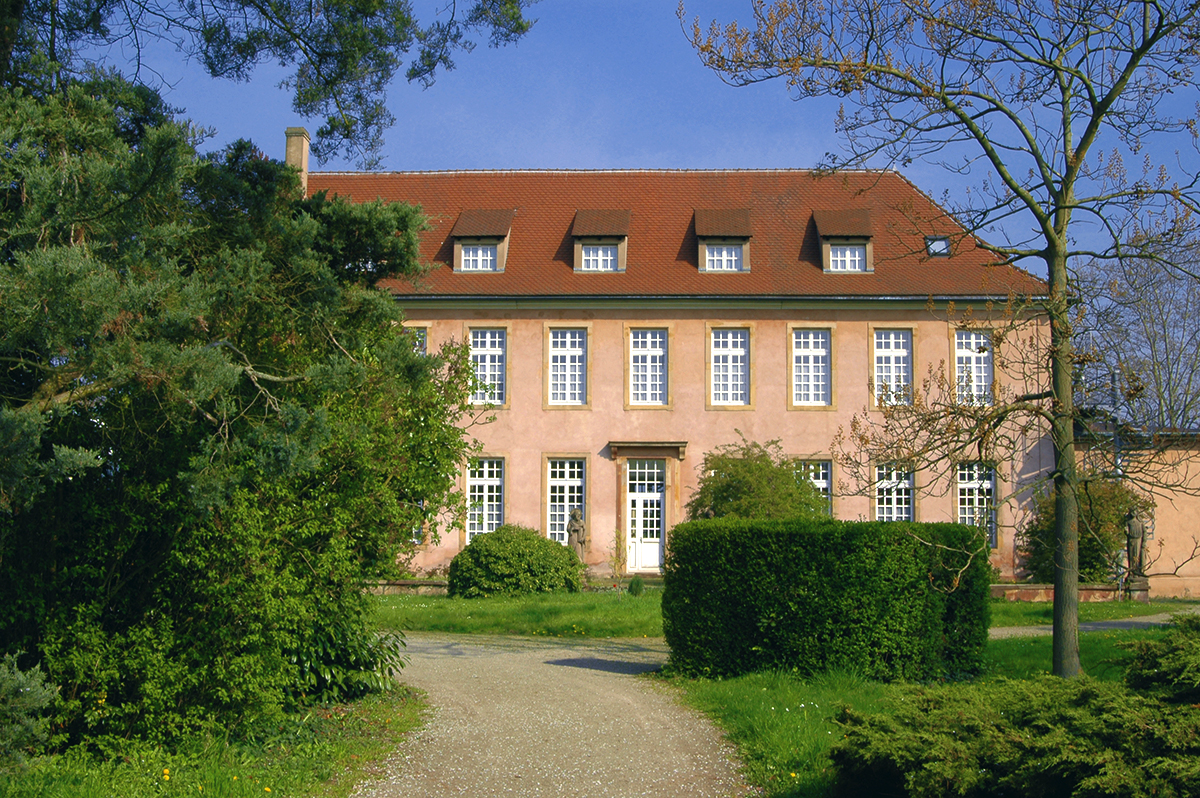
Located at the entrance to Robertsau, near the European institutions, the Saint-Thomas Cultural Center, with its functional buildings and large wooded park, offers an ideal setting for hosting seminars, training sessions, and retreats.
The “chanoine Mathieu”
The revolutionary upheavals did not spare the estate, which was confiscated in 1791 and then sold in 1797 to General Tharreau.
In 1824, the Bishopric of Strasbourg was able to repurchase it for the benefit of the major seminary. The entire sum of 24,400 francs for this repurchase came from a bequest by a former canon of Strasbourg Cathedral, Mathieu. This former royalist, now outlawed, stipulated as a condition of his bequest that the students receiving the scholarships he offered would say “a prayer for the King of France and his family” every day. A notarial act from that time used the designation “Jesuit Estate” for the first time, and a royal decree from Charles X ratified this repurchase, thus restoring the estate to its original purpose. This status remained unchanged until 1923, when the institution became the “Saint Thomas Philosophy Seminary,” preparing students from episcopal colleges, minor seminaries, and high schools for the philosophy baccalaureate. Before discussing the institution’s current phase, it is worth noting that during the German occupation of 1940-1944, the authorities withdrew the major seminary’s use and usufruct of the government buildings on Rue des Frères, but left the Robertsau building at its disposal. This building served as a refuge for the theology training and also as a shelter for 30,000 books from the seminary’s library. From 1945 to 1965, the institution reverted to its original function as a philosophy seminary.A new mission
From 1965 onward, the Saint Thomas Seminary was entrusted with a new mission.
The Second Vatican Council revitalized pastoral care with a missionary zeal: “All are responsible for the life and mission of the Church.” This call to collective responsibility required the establishment of spaces and resources for theological formation and the deepening of faith. At the initiative of Bishop Elchinger, the Maison Saint-Thomas expanded with the addition of new, functional buildings adapted to the Center’s new mission: conference rooms, dining rooms, and accommodations. Inaugurated in 1974, this excellent facility for theological and spiritual formation can accommodate groups of ten to two hundred people. Associations and organizations from civil society, drawn by the tranquility of the site and the quality of its services, frequently request training sessions. Frequented primarily by Church movements and services, but also by numerous organizations in the community, the Saint-Thomas Center, which has become a major hub for exchange, often takes on a Pentecostal character: encounters between generations, between cultures, between nations and peoples, between Churches, between continents…A sign of a Church attentive to the people of our time, the Saint-Thomas Cultural Center welcomes all those who are committed to serving the human and spiritual growth of every person.
It is inhabited by a chaplain, a family, and a religious community. A team of fifteen employees takes turns more than 300 days a year to maintain this open and welcoming center.Sources: Robert Pfister, “Metamorphoses of a Village: Robertsau from 1900 to the Present Day,” Éditions La Tour Blanche. Canon Jean-Pierre Zirnheld; Saint Odile Almanac – February 2006, Alsace-Media